THE CONFERENCE
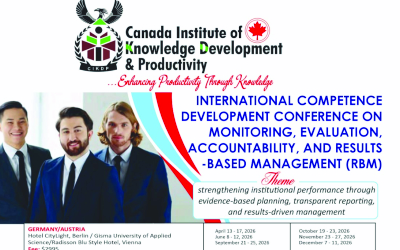
The International Competence Development Conference on Monitoring, Evaluation, Accountability, and Results-Based Management (RBM) is a global platform designed to enhance institutional effectiveness, transparency, and learning through evidence-driven systems and performance management practices.
Under the theme “Strengthening Institutional Performance Through Evidence-Based Planning, Transparent Reporting, and Results-Driven Management,” the conference brings together policymakers, development practitioners, planners, evaluators, and institutional leaders to explore modern frameworks and methodologies that promote measurable results, accountability, and strategic impact.
In an increasingly data-driven world, organizations are under growing pressure to demonstrate the effectiveness of their policies, programs, and projects. This conference focuses on advancing Monitoring and Evaluation (M&E) systems and Results-Based Management (RBM) approaches that align planning, budgeting, and reporting with performance indicators and tangible outcomes.
Through a blend of expert sessions, country case studies, and practical exercises, participants will gain deeper insights into strategic planning, performance tracking, data visualization, and impact assessment. The discussions will also emphasize how transparency, accountability, and adaptive learning contribute to sustainable development, efficient resource allocation, and trust in public institutions.
The International Competence Development Conference on Monitoring, Evaluation, Accountability, and Results-Based Management (RBM) aims to empower participants to build resilient institutions capable of designing and implementing programs that deliver real, measurable, and sustainable results for citizens and stakeholders.
By the end of this conference, participants will be able to:
▪ understand the fundamental principles and frameworks of Monitoring, Evaluation, Accountability, and Results-Based Management (RBM);
▪ design and implement effective M&E systems that support institutional planning and performance improvement;
▪ apply evidence-based approaches to program formulation, resource allocation, and decision-making;
▪ develop and use performance indicators to measure, track, and report on institutional outcomes;
▪ strengthen accountability mechanisms that enhance transparency and credibility in public reporting;
▪ utilize data visualization, dashboards, and analytical tools for performance tracking and evaluation;
▪ integrate results-based management principles into strategic planning, budgeting, and project cycles;
▪ enhance organizational learning through continuous monitoring, adaptive management, and evaluation feedback;
▪ link institutional performance with national and international development priorities, including SDGs and Agenda 2063; and
▪ build institutional culture that values transparency, evidence, and measurable impact in public and development programs.
WHO SHOULD ATTEND
This conference is particularly relevant to:
▪ Ministers, Permanent Secretaries, and Directors of Planning, Monitoring, and Evaluation
▪ Heads of Performance Management, Strategy, and Policy Departments
▪ Senior Officials from Ministries, Departments, and Agencies (MDAs)
▪ Directors of Budget, Finance, and Institutional Planning Units
▪ Monitoring and Evaluation Officers, Specialists, and Consultants
▪ Program and Project Managers from Public Institutions and Development Agencies
▪ Economists, Statisticians, and Policy Analysts involved in performance measurement
▪ Auditors, Compliance, and Accountability Officers
▪ Representatives of International Development Partners, NGOs, and Donor Agencies
▪ Academics, Researchers, and Practitioners in Governance, Economics, and Public Policy
▪ Local Government Administrators and Regional Development Coordinators
▪ ICT and Data Systems Professionals supporting M&E frameworks
▪ Civil Society and Advocacy Groups engaged in transparency and governance reform
CONFERENCE MODULES
Module 1: Foundations of Monitoring, Evaluation, Accountability, and Results-Based Management (RBM)
• Understanding M&E and RBM concepts, principles, and frameworks.
• Linking results chains, logical frameworks, and performance indicators.
• Integrating M&E within institutional planning and governance systems.
• Reviewing international best practices in results-based accountability.
Module 2: Evidence-Based Planning and Policy Development
• Using data and evidence to inform strategic and operational planning.
• Designing measurable objectives and SMART performance indicators.
• Aligning institutional plans with national development strategies and SDGs.
• Ensuring inclusivity and transparency in the planning process.
Module 3: Designing and Implementing Effective M&E Systems
• Building institutional M&E frameworks and data collection mechanisms.
• Establishing feedback loops between monitoring, reporting, and decision-making.
• Using digital tools for data collection, analysis, and reporting.
• Strengthening coordination across departments and agencies for unified results management.
Module 4: Performance Measurement, Data Analysis, and Reporting
• Developing and using performance indicators for program monitoring.
• Conducting quantitative and qualitative data analysis for informed reporting.
• Creating dashboards, scorecards, and visualization tools.
• Writing clear, credible, and results-oriented performance reports.
Module 5: Strengthening Accountability, Transparency, and Institutional Learning
• Embedding accountability systems across all levels of program management.
• Promoting transparency in results communication and stakeholder engagement.
• Using evaluation findings for continuous learning and adaptive management.
• Encouraging citizen participation and oversight in governance processes.
Module 6: Evaluation Design, Impact Assessment, and Performance Improvement
• Conducting formative, summative, and impact evaluations.
• Assessing program effectiveness and efficiency through evidence-based methodologies.
• Using evaluation results to guide resource allocation and reform processes.
• Institutionalizing evaluation culture for long-term performance improvement.
Module 7: Global and Regional Best Practices in RBM and Institutional Performance
• Exploring global models of results-based management and performance frameworks.
• Aligning institutional RBM practices with SDG and Agenda 2063 frameworks.
• Strengthening partnerships and collaboration for shared results and accountability.
• Developing post-conference action plans for institutionalization of RBM practices.
Organizational Benefits of Attending This Conference
• Strengthen Institutional M&E Systems: Build robust structures for monitoring, evaluation, and learning across programs and departments.
• Enhance Evidence-Based Decision-Making: Utilize data and performance evidence to improve planning, resource allocation, and policy formulation.
• Promote Accountability and Transparency: Establish credible reporting systems that improve stakeholder confidence and institutional integrity.
• Improve Organizational Efficiency: Link strategic planning with measurable outcomes to optimize program implementation and performance.
• Institutionalize Results-Based Management (RBM): Embed RBM practices into core governance, budgeting, and operational processes.
• Enhance Organizational Learning and Adaptation: Foster a culture of continuous improvement through evaluation, reflection, and innovation.
• Build Cross-Sector Collaboration: Strengthen partnerships among ministries, donor agencies, NGOs, and private institutions for shared results.
• Comply with International Standards: Align institutional reporting and accountability frameworks with global norms such as SDGs and Agenda 2063.
• Improve Resource Utilization: Ensure efficiency, effectiveness, and value for money in program delivery and management.
• Demonstrate Development Impact: Showcase measurable institutional outcomes that support national growth and public trust.
Personal Benefits of Attending This Conference
• Enhance Professional Competence: Acquire a deep understanding of RBM principles, performance measurement, and evaluation techniques.
• Develop Analytical and Technical Skills: Learn to design indicators, interpret performance data, and translate evidence into policy and practice.
• Strengthen Strategic Planning Abilities: Gain practical knowledge to align planning, budgeting, and implementation with institutional goals.
• Improve Reporting and Communication Skills: Master techniques for presenting data-driven results clearly and effectively to various audiences.
• Advance Evaluation and Impact Assessment Expertise: Build capacity to conduct and manage evaluations that drive program improvement.
• Increase Accountability and Ethical Standards: Promote personal integrity and transparency in managing public resources and institutional programs.
• Expand Professional Networks: Engage with peers, experts, and international practitioners in M&E and performance management.
• Gain Global Perspective: Explore international models and case studies on institutional accountability and results-oriented governance.
• Apply Digital and Data Tools: Use modern technologies for data collection, visualization, and results dissemination.
What will i learn?
Available dates
- theme “Strengthening Institutional Performance Through Evidence-Based Planning, Transparent Reporting, and Results-Driven Management,”